We call it New York Hill because they called it New York Hill
The history of the place the restaurant takes its name from.
The ghost town of Thurber, on the Erath and Palo Pinto County line along I-20, produced coal and brick from 1888 to 1921. At the time it was described as the “largest company town in the state of Texas.”
Managers for the Texas and Pacific Coal Company, many from the northeastern United States, lived in homes with picket fences and indoor plumbing. The area came to be called “New York” Hill because of them.
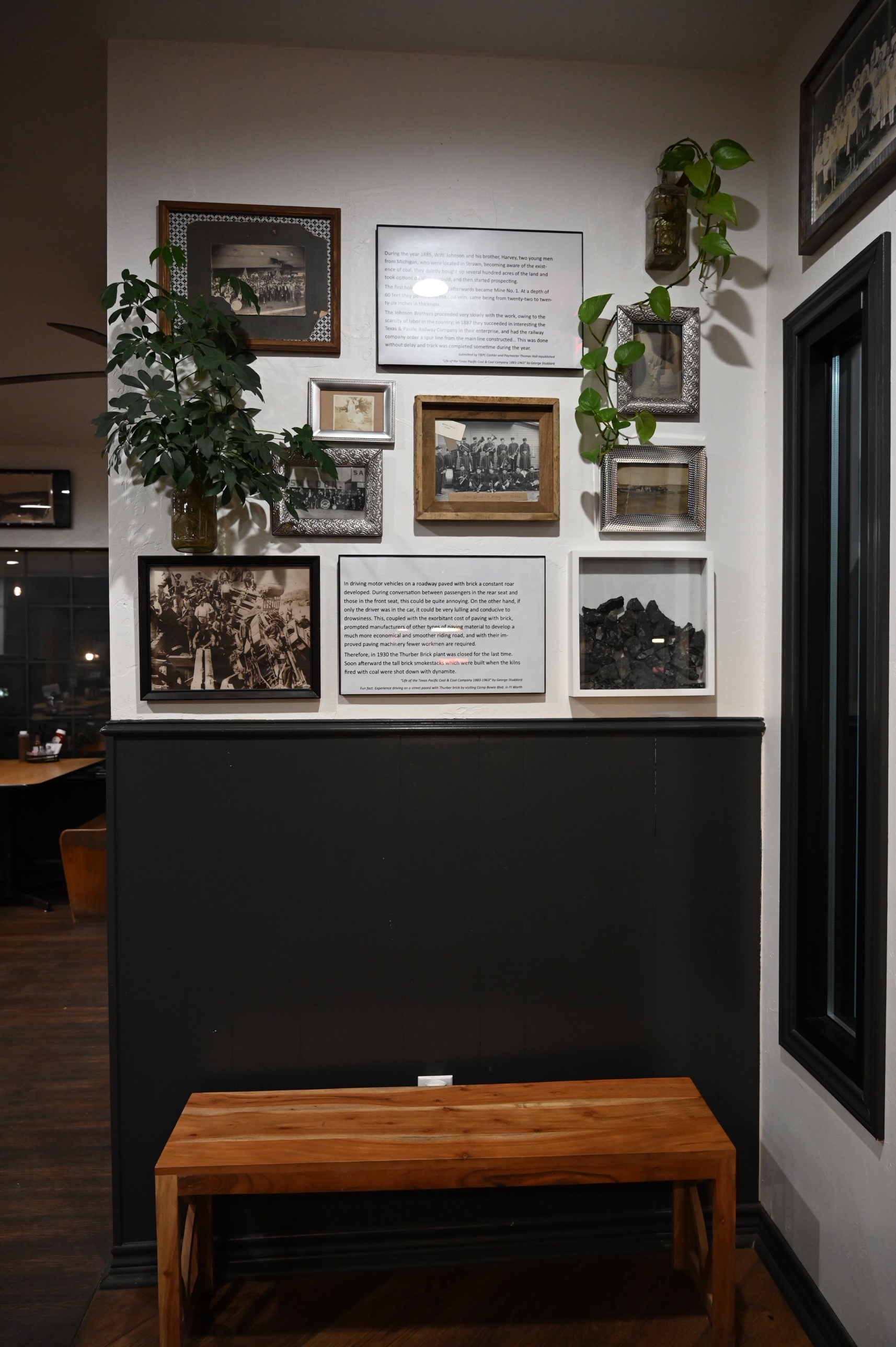
Janis and Lesly Mills chose the restaurant’s name to honor that history. Local families have donated photos and artifacts, which hang in the main dining room.
Welcome
Welcome to New York Hill Restaurant. We hope your visit here is both enjoyable and memorable. We named our restaurant “New York Hill Restaurant” in keeping with Thurber’s rich, colorful history.
This restaurant is located on the site of Thurber’s Episcopal Church, which was built about 1918. The Ranger Oil Boom, a dozen miles west of here, was on at this time, and the Texas Pacific Coal and Oil Company brought many office workers from the northeastern United States to staff its Thurber office. Fine brick homes were built for these employees on the hill south of downtown Thurber, and that hill came to be called “New York Hill.”
Five important aspects of Thurber were its coal and brick production, its ethnic diversity, its role in the labor movement, and its place in the Ranger Oil Boom. The lake to our west is Thurber Little Lake, the town’s “swimming pool.” Just north of this lake, toward town, was the school. The first coal mine was a few hundred yards east of our restaurant, with the brick plant just beyond it.
When the railroads switched from coal to oil and the Ranger Oil Boom fizzled out, Thurber’s population of 10,000 faded away, and Thurber became a ghost town. New York Hill remains a prominent feature of Thurber’s past. We hope to keep its history alive by offering a glimpse of it alongside a pleasurable dining experience.
A Brief History of Thurber
Thurber’s Beginnings
William and Harvey Johnson came to Texas in 1878 from Ionia, Michigan, one jump ahead of creditors from a failed merchandise business. They settled in Strawn, five miles northwest of Thurber, and established a successful feed, lumber and grain company. As the Texas and Pacific Railroad extended westward from Fort Worth in the early 1880s, it desperately needed coal and cross ties, and ranchers wanted cedar posts for fencing. The Johnsons supplied the cross ties and cedar posts. While searching for more timber, William Johnson met a man in northern Erath County who complained of a black, crumbly rock he had hit while digging a water well. Johnson instantly recognized coal and its potential.
It was five long years before the Johnsons had the resources to buy land and sink the first coal mine shaft. A crude mining camp, Johnsonville, grew up with a general store, a saloon, shacks and tents. The Johnson Brothers Coal Mining Company could not operate profitably with the wage demands of the Knights of Labor. When the miners struck in 1888, the mine was sold to Robert Dickey Hunter.
Hunter was a feisty, tight-fisted Scottish-American who swore “to run my business or run it to hell.” He called the town Thurber, after one of the investors. He kicked out the Knights of Labor, lowered wages, and brought in outside miners. Everything in Thurber was company-owned: stores, houses, utilities, churches and saloons. Hunter built a four-strand barbed wire fence around 900 acres of Thurber, and guards patrolled the perimeter to keep out agitators and to prevent residents from making outside purchases. Texas Rangers were called in four times before Thurber calmed down.
Hunter’s miners were paid $1.05 per ton for hard work digging a 27-inch seam of coal from a prone position, 10 hours a day, six days a week. Still, Hunter poured money into making Thurber the most modern city in the Southwest, with electricity and running water in every home. There were no city taxes and no unemployment. Band concerts, classical operas and stage plays in a first-class opera house provided entertainment. The miners continued to complain about three things: low pay, the fence around the city, and the screening of coal. Through screening, miners lost 15–20% of their earnings, because they were paid for “lump” coal that would not pass through the screen openings, which were the size of a baseball.
Brick Making
By 1897, Hunter had turned over most of his duties to his mining superintendent, W. K. Gordon. Gordon was the opposite of Hunter: calm, polite, thoughtful, respected and well liked by all. With Gordon handling most of Thurber’s operations, Hunter turned to brick making, setting up the Green and Hunter Brick Company of Thurber, Texas. The pea coal that fell through the screens, and for which miners received no pay, fired the brick kilns. A large deposit of high-grade shale was available on Thurber land.
Eighteen kilns turned out 80,000 bricks a day, and Thurber brick was said to be the “best brick west of the Mississippi.” Thirty-five types of brick were made in Thurber, but the specialty was paving brick. Thurber paving brick covered Congress Avenue in Austin, Camp Bowie and the Stockyards in Fort Worth, portions of the Old Bankhead Highway in North Central Texas, and many streets in Mineral Wells, Strawn, Ranger, Eastland and Cisco. Power for the brickyard came from a Corliss steam engine the brickyard called “Old Hunter.”
Road builders began paving with asphalt, and the Depression slowed road building. The Thurber Brick Plant ceased operations in 1931, and the plant was salvaged. Today, the only reminders of brick making are the brick walls, foundations and scattered remnants of bricks.
The Miners’ Strike of 1903 and the Labor Movement in the Southwest
Since 1898, when R. D. Hunter kicked out the Knights of Labor, union activity was strictly forbidden in Thurber. Organizers were beaten and thrown outside Thurber’s barbed wire fence. By 1903, conditions had changed. The Texas and Pacific Coal Company had a huge investment in Thurber, including machinery, buildings, houses, utilities, a brick plant, a dairy, merchandise and stores, and the company was vulnerable to a strike. By 1900, the coal miners in nearby Strawn and Lyra were organized, and the United Mine Workers turned their attention to Thurber.
Organizing Thurber’s miners was difficult because of the many languages spoken by immigrant miners. Multilingual organizers were required, especially Italian, Polish and Spanish speakers. Thurber miners walked out, and on Friday, September 11, 1903, miners and families began leaving Thurber. By Monday, Thurber was totally abandoned, and an uncanny silence covered the city.
On October 8, 1903, a union charter was granted to the miners of Thurber. Because this was the first successful labor strike in the Southwest, it is considered the beginning of the labor movement there. From a strictly non-union town, Thurber became the first totally unionized city in America. Seven different unions covered every worker in Thurber. The fence came down, pay went up, and the coal screen was removed. The brick makers were granted a unique concession: each Thurber brick was stamped with a union symbol, a triangle with the letters “B,” “T” and “T” at its apexes, for “Brick, Tile and Terracotta Workers of America.”
There was another twist to the unionization of Thurber’s miners. All union officers were English-speaking Americans, and there were three times as many Italian miners as any other ethnic group. The Italians complained that union officers ignored their grievances and religious holidays, and they threatened to bring in the Industrial Workers of the World (IWW), a socialist-leaning union. As a result, in 1906 the UMW also granted the Italian miners Charter #2763. The Polish, Mexican and African-American miners switched to the “Italian Local,” which made it several times larger than the English-speaking local.
Ethnic Diversity of Thurber
If Ellis Island was “The Melting Pot of the World,” Thurber was “The Melting Pan.” Eighteen different immigrant nationalities made up Thurber’s population. Thurber was another example of America opening its arms to the oppressed, and many Eastern European immigrants came to escape brutal socio-economic conditions in the “Old Country.”
The Italians were the most colorful of the immigrant groups, with their singing, bocce ball games and outdoor bread ovens. Many Italians were trained musicians who formed several outstanding bands in Thurber, including the official town band, the Hunter Band, which often played at the Fat Stock Show and the State Fair of Texas. Weekly band concerts were held. When the miners were thrown out of work in 1921, Prohibition was in force, and many Italians in nearby Thurber Junction turned to bootlegging. Their “grappo” (grape) whiskey was potent and renowned.
The Poles were known for three-day wedding celebrations, where men would throw a gold coin at a dinner plate, trying to break it to earn the privilege of a dance with the bride. Thurberites always looked for an excuse to celebrate: a wedding, a holiday, a religious feast day, a baptism, or a visiting dignitary. Three dance pavilions were spread across Thurber.
Ethnic groups clustered in different sections of town. The Mexicans lived on Stump Hill, west of Little Lake; the Poles on Polander Hill, north of Stump Hill and across I-20; and the Italians on Italian Hill further north. The African-Americans lived at the foot of New York Hill, and the New Englander oil people lived on New York Hill itself. The rest of the population was spread around downtown Thurber.
Thurber’s Decline
The years from 1903 to 1920 were good years for the Thurberites. There was stability, families grew, and there was security in work and in belonging to a great nation. Thurber coal production peaked at 2,000 tons per day in 1915.
Ever since Spindletop at Beaumont, Texas, in 1901, the big money talk was oil, and some railroads changed from coal to oil before World War I. W. K. Gordon, Thurber’s general manager, began drilling test holes for oil in 1913 and was convinced oil was in Thurber’s vicinity. He leased 300,000 acres for the T&P Coal Company. In 1917, Gordon’s first well, the Nannie Walker in Ranger, a dozen miles west of Thurber, hit gas. The well was abandoned because there was no market for gas at the time. The second well, the McClesky, blew in strong, and the Ranger Oil Boom was on.
By 1916, Thurber coal miners had walked out for three weeks to win a 5¢ per ton wage increase. It was apparent the limit of coal profitability was being reached. By 1921, most railroads had switched from coal to oil, and coal orders kept falling. The company was renamed “The Texas and Pacific Coal and Oil Company,” and it proposed a wage cut. The union declined, and the company locked out the miners and ordered them to leave company housing. The Thurber coal mines closed after thirty years, and the miners drifted away to find work elsewhere.
In 1931, the Thurber Brick Plant closed, and the Ranger Oil Boom had fizzled out. The T&P Oil Company, as it was now called, moved its headquarters from Thurber to Fort Worth. The company salvaged and sold nearly everything in Thurber except two brick buildings, the smokestack, the fire station and three houses.
An estimated 127,000,000 tons of coal remain under Thurber. Many believe that when oil and gas run out, modern technology such as gasification will recover Thurber’s coal.
We hope you enjoy the history we have on display! We want to thank those who helped collect and donate items for all to enjoy. The history on this menu was gathered from information received from Leo Bielinski, the Tarleton Library Southwest Collection (Texas Tech), Weldon Hardman’s Fire in the Hole, and the Thurber Historical Association. Special thanks go to Gay, Brother Bill, Carolyn, Monya, Alma, Leo, Bob and Max. We couldn’t have done it without you. Our sincere gratitude goes to you, our customers, who have helped make our dream a reality.
Love and Appreciation,
The Mills Family
Nearby Attractions
- W.K. Gordon Center for Industrial History of Texas A Tarleton State University museum in the old company town, with interactive exhibits on Thurber’s boom-to-bust story. Open to all ages. 65258 Interstate 20, Mingus · (254) 968-1886
- Thurber Historic District Walk the streets of the ghost town and look for the historic smokestack, the miner’s house, and the old bandstand. The smokestack is visible from I-20.
- Palo Pinto Mountains State Park Texas’ newest state park, opened in 2026 on about 4,900 acres of juniper hills. Hike or bike more than 16 miles of trails, and fish, swim, or paddle on 90-acre Tucker Lake (non-motorized boats only). Campsites range from primitive to electric. 100 Park Road 77, Strawn · $7 adults, free for children 12 and under.
- Possum Kingdom Lake Boating, fishing, swimming, and hiking are all popular on the lake.
- Stephenville The Erath County Courthouse, a stroll through the Tarleton State University campus, and the Stephenville Historical House Museum. About 23 miles away in a straight line.
Gordon Center hours change, so check before you visit.
As Seen on The Daytripper
Host Chet Garner visits the Thurber area on PBS’ The Daytripper. The episode covers the coal town that is now a ghost town, a chicken fried steak, and homemade rolls.